
Xiaohongshu (also known as Rednote) isn't a platform where you buy reach — it's one where you earn it. Platform algorithm changes increasingly favor authentic content over advertising, benefiting brands that invest in community building. With 376 million monthly active users globally and daily post views reaching 9.12 billion, the stakes for getting your content strategy right have never been higher.
The platform processes over 1 billion search queries monthly, making it a crucial touchpoint in the Chinese consumer journey. Behind that scale is a precise, unforgiving, and constantly evolving recommendation engine. For brands that understand it, the rewards are real: Xiaohongshu delivers a 21.4% conversion rate for global brands — a figure most Western social platforms can't touch.
This guide breaks down exactly how the Xiaohongshu (also known as RedNote or Little Red Book) algorithm works, what drives post rankings, and the optimization strategies your brand can start using today.
The Algorithm's Core Mission and Logic
The algorithm has one overriding goal: deliver the most relevant, genuine, and high-quality content to each user — while keeping the community clean and protecting it from low-quality or manipulative content.
The result is a three-part operating logic:
● Authenticity first. Hard-sell advertising, copy-paste content, and false claims are actively penalized. Original, experience-driven, real content wins.
● User behavior as the quality signal. The algorithm doesn't take your word for it that your content is good — it watches how users actually behave, then decides.
● Dual-engine distribution. Every post competes for two types of traffic simultaneously: the Discover feed (recommendation-driven) and the Search results page (intent-driven). Winning brands optimize for both.
This is the fundamental shift brands need to internalize: Xiaohongshu(RedNote) is not an ad platform with a community bolted on. It's a trust platform, and the algorithm enforces that.
From Publish to Exposure: How the Algorithm Distributes Your Content on Xiaohongshu (RedNote)
Every post goes through a staged, gated distribution process. You don't get traffic because you posted — you get traffic because your data earned it.
Stage 1: The Sandbox Period
New accounts enter an observation window lasting days to weeks. New accounts face a colder start: accounts with fewer than 180 days of consistent activity receive limited visibility. Long-term content contribution pays off — creators active for more than 180 days receive bonus exposure and traffic rewards.
During this period, the algorithm is asking a simple question: is this a real person posting genuinely useful content? Accounts that post hard-sell content immediately, or that exhibit bot-like behavior, get throttled before they've even started.
The playbook for new accounts: spend the first 7–10 days behaving like a normal user — browse, engage, comment — before publishing your first post.
Stage 2: Compliance Review
Before any post enters the recommendation system, it passes through automated and human review. Content that fails never reaches an audience. Common failure points include:
● Superlative or absolute claims: "best," "number one," "guaranteed results"
● Sensitive categories: medical efficacy claims, political topics, anything sexually suggestive
● Off-platform redirects: WeChat IDs, phone numbers, QR codes, external links
● Spammy behavior: repeated posting of near-identical content, which flags the account as automated
Stage 3: Small-Pool Testing (100–500 Users)
Each new RedNote post enters a traffic pool trial, where it is shown to 100–500 users. Posts are automatically tagged by the system based on content and context. The algorithm uses your title, cover image, hashtags, and body text to classify the post and match it to a relevant test audience. How this audience responds determines everything that follows.
Stage 4: Tiered Amplification
Strong early data moves a post into progressively larger pools: 1,000–5,000 users, then tens of thousands, then potentially hundreds of thousands. Average performance means the post stalls and remains visible only to followers.
Poor performance means it essentially disappears. This feature essentially means that immediately attract users is more important than ever. The timing of the post is also very important, you would want the post to reach the right audience almost right after posting.
The rule is simple: good data earns traffic. No shortcuts.
The CES Scoring System: What Actually Drives Rankings
Xiaohongshu uses a CES (Clickthrough & Engagement Score) framework to evaluate content quality.
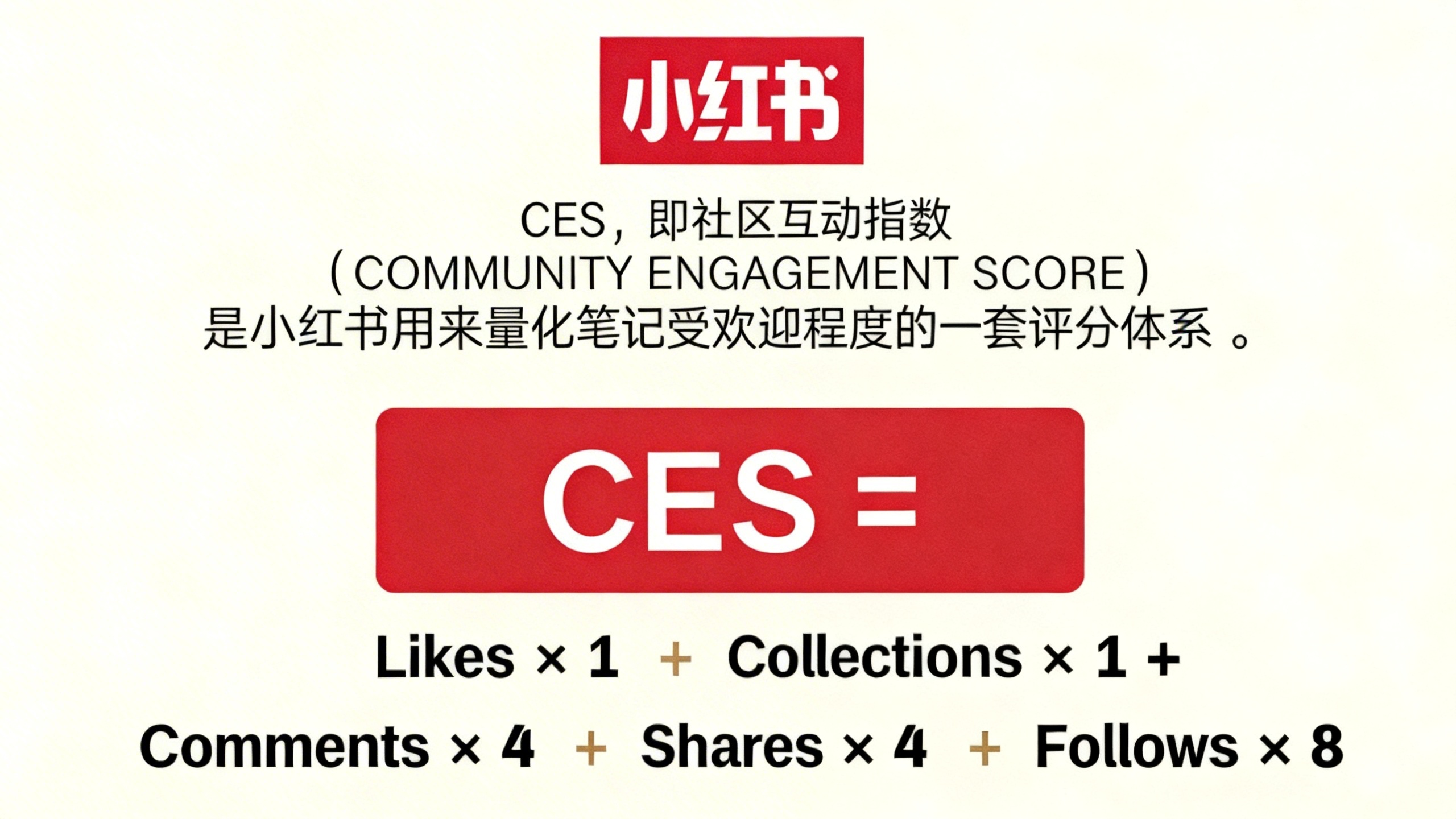
The CES scoring system applies a weighted score based on Likes (1pt), Collections (1pts), Comments (4pts), Shares (4pts), and Follows (8pts). Folllows carry the highest weight, representing long-term "seeding" value.
This weighting has direct strategic implications. Brands that chase likes are optimizing for the lowest-value signal. The actions that actually move rankings — saves, comments, follows, shares — all require a deeper level of engagement. Your content needs to be good enough that people want to keep it, talk about it, or tell others about it.
Five Factors That Determine Your post's Ranking
1. Originality and Authenticity
Posts must be at least 60% original to be considered for broader promotion. Real photos, personal experiences, unfiltered before-and-after comparisons, and honest reviews outperform polished brand copy every time. 82% of Chinese consumers prefer social media for researching and verifying information about new products— they're on Xiaohongshu specifically because they trust peer voices over advertising.
Content that reads like an ad gets treated like one. In this regards Xiaohongshu user behavior is very similar to that of Reddit.
2. Engagement Rate and Speed
Interaction rate, interaction velocity, and interaction quality all feed into your CES score. The first 1–3 hours after publication are the most critical window — the algorithm uses this period to size the initial traffic pool. Front-load your engagement efforts: notify existing followers, prepare a strong hook in the opening lines, and be ready to reply to early comments.
3. Click-Through Rate (CTR)
Your cover image and title determine whether someone taps your post at all. Xiaohongshu (also known as RED)'s algorithm prioritizes content based on user engagement metrics, particularly likes, comments, and shares within the first posting hours. A high CTR signals relevance and interest, feeding more impressions.
● Cover page (the first picture of the carasoul or the thumbnail for videos) should be bright, clean, and subject-focused.
● Titles should address a pain point, a desire, or a specific use case — not just name the product.
4. Time-on-Content
The longer users read or watch your post, the stronger the signal that your content has real depth. Long-form educational content, step-by-step tutorials, and comparison reviews all tend to perform well on this metric because users actually read them fully. From the experience of working with 3000+ clients, we had created a list of common topics that had historically performed well:
● Personal and honest review of everything, from beauty product to public restroom in New York City.
● Industry knowledge explained in simple terms and clear structure. RedNote users would love to learn about neuroscience or japanese grammar on a daily scroll
● Nuanced social topics that leads to postive ending. It‘s a difficult world, morale is down, but people still love to see a good samaritan gets their rewards.
● A peak outside of China. What the other half of the globe is eating, watching, and doing is of great interest on Xiaohongshu. The TikTok refugees that reached hundreds of thousands of followers is the most solid proof.
5. Account Authority
Account history matters. A vertically focused account that has posted consistently in one category, maintained clean compliance, and built genuine followers starts each new post with a higher baseline weight. Accounts that jump between unrelated topics, have prior violations, or show signs of purchased engagement see their distribution throttled at the source.
Recommendation Feed vs. Search: Why You Need Both
Xiaohongshu traffic comes from two separate systems with different ranking logic: the Discover feed (very similar to the For You page on TikTok), an the Search page. Winning brands don't pick one — they engineer content that captures both.
The Recommendation Feed (Discover)
The Discover feed is interest-based. The algorithm models each user's preferences from their behavior history and surfaces content it predicts they'll engage with. To win here, you need high CTR, strong engagement, good read-through, and emotional or informational resonance. Lifestyle content, trend-driven posts, and scenario-based storytelling thrive in this environment.
Search Results
According to Xiaohongshu, nearly 70% of monthly active users have search behavior on Xiaohongshu, and one-third of monthly active users go straight to searching as their first action upon opening the app. Since the fourth quarter of 2024, Xiaohongshu's daily search volume has reached nearly 600 million, doubling in a little over a year. This makes keyword strategy non-negotiable.
Similar to the SEO that most of you know, Xiaohongshu (also known as RED) search ranking is determined by keyword relevance, content depth, account authority, and engagement history on the post. RED's algorithm places heavier emphasis on "social signals" and "instant feedback" compared to traditional search engines — meaning a post that ranks well socially also tends to rank well in search.
The optimal strategy: write one post that serves both engines. A cover and title that drive discovery-feed clicks, combined with body copy that naturally embeds your target keywords, gives you organic distribution from two directions simultaneously.
Practical Optimization Playbook for Brands
Account Setup: Build Authority Before Chasing Traffic
Pick a content vertical and commit to it. A beauty brand publishing skincare, food, and travel content confuses the algorithm's classification system and dilutes account authority. Consistent topical focus helps the platform understand exactly who to show your content to.
For enterprise brands, pursue Blue V verification. It unlocks advertising tools, storefront access, and paid promotion capabilities — and signals platform legitimacy to both the algorithm and users.
Content Creation: What the Algorithm Rewards
Sharing both positive aspects and honest limitations of products builds trust with the audience and improves long-term brand reputation.
● Replace "product introduction + promotion" with "experience + review + scenario + insight."
● Use real photos.
● Show before-and-after comparisons.
● Share genuine assessments, including limitations.
For cover images, shoot for 1080x1350px (3:4 ratio), high brightness, and a clear subject. Add a short, benefit-driven text overlay if it helps. For titles, lead with the user's pain point or desired outcome and include your primary keyword. Example: "3 Foundation Tricks for Dry Skin That Don't Cake in Winter."
Structure your body copy for skimmers: short paragraphs, natural section breaks, and symbols for visual breathing room. Front-load your core insight — don't bury the lead.
Keyword Strategy: Own Your Search Real Estate
Build a two-tier keyword architecture:
● Core keywords: your brand name, product category, specific product names.
● Long-tail keywords: scenario + benefit + audience combinations, such as "sensitive skin autumn moisturizer" or "small apartment storage hack." Long-tail keywords containing three to five words capture user intent more precisely and face less competition than broad terms.
Distribute keywords across:
● title (primary keyword),
● opening paragraph (natural mention),
● body (two to three times),
● closing paragraph (once), and hashtags.
Never stuff — one unnatural keyword cluster can tank your post's tone and hurt engagement, which loops back to hurt ranking.
For hashtags, use 3–8 focused tags combining your vertical, product, and use-case. The algorithm penalizes violations — overused hashtags can tank your reach. Ericanfly More is not better.
Engagement Optimization: Activate the Data That Matters
End posts with a genuine question that invites comment
It should be tied to your content topic: "Which finish do you prefer in winter — matte or dewy?" or "Would you rather see a budget or premium option tested next?" These prompts drive the high-value CES signals (comments, saves, follows) that push posts into larger traffic pools.
Respond to early comments quickly
Every reply increases engagement velocity during the critical first-hour window and builds the community feel that Xiaohongshu's algorithm rewards.
For content types that naturally drive saves — ingredient guides, skincare routines, how-to tutorials, packing lists — include a soft prompt in the post body: "Save this for reference before your next purchase."
Paid Amplification: Use It Correctly or Not at All
Xiaohongshu's official paid tool is called 薯条 (Shǔ tiáo). It allows targeted promotion to specific audience segments, and it is algorithm-approved — meaning boosted posts still go through the same quality evaluation as organic content.
The correct use case: take a post that has already passed organic testing with strong data, and use paid amplification to scale its reach. Do not use paid promotion to prop up weak content. Micro-influencer partnerships emphasizing authenticity over reach consistently outperform paid hard-sell content. If your organic data is poor, fix the content first.
Algorithm Violations to Avoid
These are the mistakes that can permanently damage an account's standing:
Hard-sell content — posts that read like product listings with prices and purchase links are throttled immediately.
● Off-platform redirects — any attempt to move users to WeChat, phone, or external sites will result in the post being penalized or removed.
● Fake engagement — purchased likes, comments, and saves are detected, cleared, and penalized with account trust score reductions.
● Repetitive content — posting very similar posts at high frequency triggers automated spam classification.
● Medical and efficacy claims — any language suggesting clinical results, medical benefits, or guaranteed outcomes triggers regulatory review.
The Long Game: Algorithm as a Tool, Content as the Foundation
The Xiaohongshu algorithm is not a system to game — it's a system that rewards the right behavior at scale. The algorithm rewards content that educates, inspires, or solves a real problem.
For brands, the clearest path forward is not to find loopholes, but to build a content operation that actually serves your audience: consistent vertical focus, genuine product storytelling, keyword-smart writing, and authentic community engagement. Paid tools amplify what's already working — they can't create it.
China's social commerce market is projected to reach $537.29 billion in 2025 Yahoo Finance, and Xiaohongshu sits at the high-trust, high-intent end of that market. The brands winning here are the ones that have accepted a counterintuitive truth: the less your content looks like marketing, the better it performs.
The algorithm will keep evolving. The brands that build their presence around real content, real engagement, and long-term community trust won't need to keep up — they'll already be ahead.