
When international brands hear that WeChat has 1.38 billion users, the reaction is almost always the same: that's where people chat with their parents and order lunch — not close enterprise deals. That instinct makes sense for marketers trained on Western platforms, where personal and professional life stay neatly separate.
But in China, business and life run on the same app, and many companies use WeChat or WeCom in place of Slack or Microsoft Teams.
This article breaks down exactly how WeChat and LinkedIn require different strategies, different content logic, and different audience assumptions — so B2B marketers can stop applying the wrong rulebook to the wrong platform.
Whether you're an international brand trying to reach Chinese decision-makers or a Chinese brand building credibility abroad, understanding the structural difference between these two platforms is where every smart WeChat B2B marketing strategy begins.
Two Platforms, Two Completely Different Games
WeChat and LinkedIn are not competing versions of the same thing. They are architecturally different platforms built for different relationships, different content behaviors, and different roles in the B2B sales cycle.
LinkedIn is an open discovery network. A prospect can find your brand without ever having heard of you. The algorithm surfaces content to cold audiences, company pages compete for organic reach, and thought leadership is the primary currency of credibility. The platform is built for awareness — getting in front of people who don't know you yet.
WeChat is a closed, relationship-first ecosystem. Followers opt in deliberately. Content lives behind an account that users have chosen to follow, and discovery happens almost entirely offline — at events, through referrals, via colleague recommendations.
The platform is built for retention, not reach.
This architectural difference isn't a minor tactical detail. It determines content format, publishing cadence, audience assumptions, and the strategic role each platform plays in your funnel.
A brand cannot port its LinkedIn approach to WeChat, or its WeChat approach to LinkedIn, and expect either to work.
The starting point is accepting that these are two separate games with two separate rulebooks.
WeChat Is Your Brand's Second Website in China
For Chinese B2B decision-makers, a company's WeChat Official Account is often more credible than its corporate website. It signals that a brand is present, active, and committed to the Chinese market in a way that a translated website simply cannot.
WeChat users spend an average of 79 minutes on the platform every day, and more than 80% follow at least one Official Account. For B2B brands, this means your content isn't competing for a brief scroll — it's entering an environment where professional information is actively consumed as part of the daily routine.
What a WeChat Official Account Actually Does for B2B Brands
A verified WeChat Official Account functions as a brand hub: it hosts your published articles, displays your verification status, links to Mini Programs, and allows followers to contact your team directly through the account interface. For a Chinese procurement manager or IT director evaluating a foreign vendor, this account is often the first place they go to verify legitimacy and assess expertise.
The verification badge matters. The article archive matters. The consistency of publishing matters. A dormant or unverified account sends a clear signal that a brand either doesn't take the Chinese market seriously or doesn't know how it works — neither of which is a position any international brand wants to be in.
If you're building this from scratch, WeChat Official Account management for international brands requires platform-specific setup, content strategy, and ongoing publishing — not a one-time launch.
Why Mini Programs Matter for Conversion, Not Just Convenience
Mini Programs — lightweight apps that run natively inside WeChat — are where WeChat's B2B conversion potential becomes tangible. Brands that link Mini Programs to their Official Accounts create a seamless path from content consumption to lead capture, event registration, product demonstration requests, or white paper downloads — all without the user ever leaving WeChat.
Brands that use Mini Programs effectively see conversion rates 30 to 40% higher than those relying on external links that push users out of the ecosystem. In a platform built on staying inside, friction is the enemy of conversion.
Your WeChat Audience Is Already Warm — And That Changes Everything
One of the most important — and most misunderstood — dynamics of WeChat B2B marketing is the temperature of the audience. Unlike LinkedIn, where a well-distributed piece of content might reach thousands of cold prospects who have never encountered your brand, WeChat followers have almost always had some prior real-world contact before they tap "Follow."
They met someone from your team at an industry conference. A colleague forwarded one of your articles. They scanned your QR code at a trade event. By the time a prospect is reading your WeChat content, they are already in the funnel.
This changes everything about how content should be written. On a cold-reach platform, hooks and attention-grabbing headlines drive performance. On WeChat, where the audience is already engaged, depth and consistency are what build trust and move buyers forward. A WeChat content strategy optimized for reach is solving the wrong problem.
The implication for publishing cadence is equally important. Irregular publishing — going quiet for weeks and then posting a burst of content — erodes the trust that WeChat audiences extend by default. Consistency isn't just a best practice; it's the expectation the platform creates.
On LinkedIn, Thought Leadership Wins — Not Product Announcements
LinkedIn's content logic is almost the mirror image of WeChat's. Where WeChat rewards depth and evidence for an already-engaged audience, LinkedIn rewards perspective-driven insight for audiences encountering your brand for the first time.
According to the Edelman and LinkedIn B2B Thought Leadership Impact Report, 73% of B2B decision-makers find thought leadership more trustworthy than traditional product marketing materials, and 70% say they think more positively of a brand that consistently produces high-quality thought leadership content.
These numbers point to a clear platform logic: on LinkedIn, earning trust comes before earning interest, and trust is built through ideas, not announcements.
This is where many Chinese brands going global structurally underperform. Alibaba Cloud, Tencent Cloud, and Huawei Cloud all bring significant technical depth and real market credibility to LinkedIn — but their content often defaults to the announcement-driven format that performs well on WeChat.
Product launches, partnership news, and event recaps dominate their feeds. For a Western B2B buyer encountering these brands cold on LinkedIn, there is rarely a perspective-driven insight or a point of view that builds genuine professional trust.
It is also worth noting that personal accounts on LinkedIn consistently outperform company pages in reach and engagement — and the gap is widening. A company page with 50,000 followers will typically generate a fraction of the impressions that a senior executive's personal post generates with 5,000 connections. For brands investing in LinkedIn, activating leadership voices is not optional; it is the primary distribution mechanism.
For Chinese brands building a cross-border B2B media strategy, understanding this distinction — and rebuilding content strategy around it — is the prerequisite to any meaningful LinkedIn performance.
WeChat Content Is a Sales Tool, Not a Marketing Channel
On WeChat, content doesn't just raise awareness — it moves deals forward. Chinese B2B buyers forward white papers to the CFO to justify budget. They screenshot case study data and share it internally during vendor evaluation. They use detailed industry reports as reference material in procurement discussions.
WeChat content, at its best, functions as a distributed internal sales tool that travels through an organization without the vendor ever being in the room.
This means the standard for WeChat B2B content is evidence over claims. Marketing language — slogans, brand promises, aspiration-led copy — consistently underperforms. What converts is specificity: measurable outcomes, named clients, technical depth, and transformation narratives that a buyer can take seriously.
How SAP China Gets It Right
SAP China's WeChat Official Account is a benchmark for how an international brand can rebuild its content strategy for the Chinese professional context rather than simply translating from English. Their published articles cover digital transformation case studies with specific ROI figures, industry-specific implementation guides, and technical deep-dives into platform capabilities. The content is built to be forwarded — it gives a procurement manager or department head something they can use to make the case internally.
This content was not adapted from SAP's global LinkedIn playbook. It was purpose-built for the WeChat context: longer form, evidence-led, and designed for the internal buying journey rather than external brand awareness.
Microsoft China applies a similar logic — technical authority content, localized partner case studies, and transformation narratives that reflect the actual decision-making process of Chinese enterprise buyers.
To see how WSD has helped global brands build WeChat content strategies with the same level of platform-native intentionality, explore our client case studies.
The Content Formats Chinese B2B Buyers Actually Use Internally
The content formats that consistently perform in WeChat B2B contexts are: detailed industry reports, client transformation case studies with measurable outcomes, technical implementation guides, white papers with original data or research, partner insights and co-authored content, and discussion-prompt articles that invite professional reflection. The common thread is that all of these formats are built to be shared internally, referenced in meetings, and used as decision-support material — not consumed and forgotten.
Why Chinese Cloud Brands Struggle on LinkedIn (And What It Reveals)
The performance of Chinese cloud brands on LinkedIn is one of the clearest illustrations of what happens when a WeChat content strategy is applied to a platform with entirely different rules.
The Fragmentation Problem: Regional Pages With No Consolidated Authority
Tencent Cloud's LinkedIn presence is divided across multiple regional pages — a global account with around 33,000 followers, a North America page with approximately 1,323 followers, and a Singapore page with around 614 followers. Each page publishes independently, with little content coordination and no unified brand narrative.
The result is authority dilution. A Western decision-maker who encounters Tencent Cloud through LinkedIn search is likely to land on a regional page with minimal follower count and sparse content history — not an impression that builds confidence in a brand competing against AWS, Azure, and Google Cloud. Every follower that should be consolidating on a single authoritative presence is instead scattered across accounts that individually signal low investment and low reach.
This fragmentation problem is not unique to Tencent Cloud. It reflects a common assumption that regional LinkedIn pages are a localization strategy when, for most B2B brands, they are a credibility liability.
When Geopolitics Sets the Ceiling: The Huawei Cloud Case
Huawei Cloud represents the most LinkedIn-invested of the major Chinese cloud providers, with approximately 81,000 followers — a meaningful presence relative to its Chinese competitors. The content is more consistent, the publishing cadence is more regular, and there is a greater attempt at perspective-driven content alongside product announcements.
But Huawei Cloud faces a ceiling that no content strategy can overcome: geopolitical friction. For a significant portion of the Western enterprise buyer market, Huawei's presence on a vendor shortlist triggers regulatory, reputational, or procurement policy concerns that are outside the scope of marketing to resolve. The content performance is limited not by strategy, but by structural factors that sit above the marketing function entirely.
The lesson this case reveals is broader than Huawei: running LinkedIn campaigns detached from a long-term content strategy means that brand equity never accumulates between campaign flights. When the ads stop, there is nothing left. The brands that have built durable LinkedIn credibility — regardless of origin — have done so through consistent, perspective-driven content that continues working whether or not paid media is running.
The Practical Difference: What Each Platform Actually Requires
The following summary is designed to function as a working reference for marketing teams aligning on platform strategy.
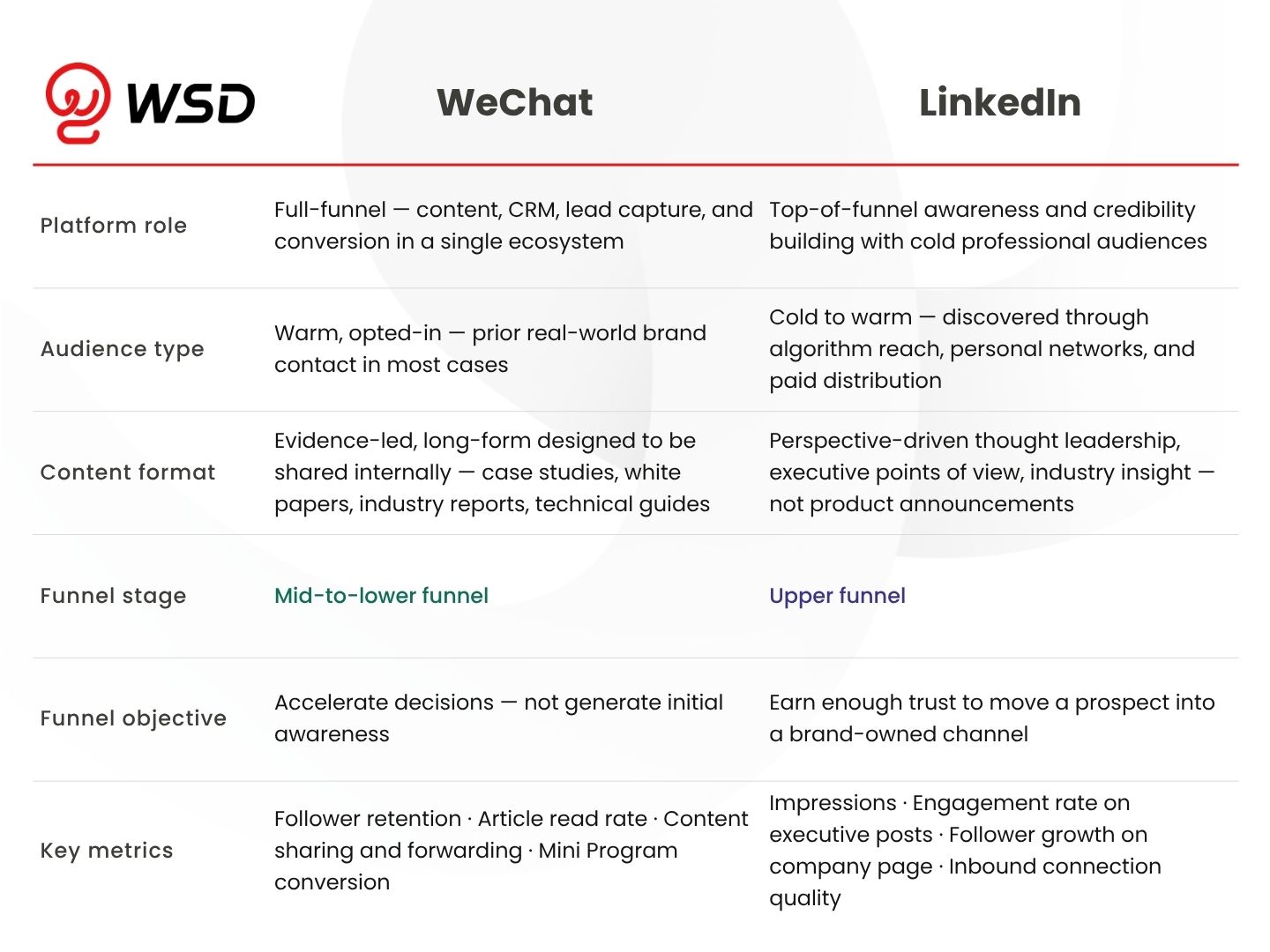
The strategic implication is straightforward: WeChat and LinkedIn are not interchangeable, and they are not in competition.
They serve different audiences at different funnel stages in different geographies. A well-structured cross-border B2B strategy uses both — but uses each for what it is actually built to do.
For brands ready to measure what is actually working across both platforms, WeChat CRM and marketing analytics provide the visibility needed to connect content activity to pipeline outcomes.
For more B2B marketing guides covering China and global markets, visit WSD's industry insights hub.
Frequently Asked Questions
Q: What is the difference between WeChat and LinkedIn for B2B marketing?
WeChat is a closed, retention-first ecosystem where followers have opted in after real-world contact and content functions as an internal sales tool for buyers moving through a purchase decision. LinkedIn is an open discovery network where thought leadership builds awareness with cold audiences who have never encountered your brand. The platform mechanics, content format requirements, and funnel roles are fundamentally different — the same strategy will not work on both.
Q: Can international brands use WeChat for B2B marketing?
Yes — but only with a China-specific strategy. International brands need a verified WeChat Official Account, content that is rebuilt for Chinese professional audiences rather than translated from English, and a clear understanding that WeChat functions as a brand's second website in China. WSD is a WeChat-certified agency that has built and managed Official Account programs for international brands across multiple industries.
Q: Why do Chinese brands struggle on LinkedIn?
Most Chinese brands carry over a WeChat content logic — product announcements, event recaps, partnership news — to a platform where Western buyers expect perspective-driven thought leadership. Running paid campaigns without a consistent organic content strategy means brand equity never accumulates between campaign flights. The brands that perform best on LinkedIn have rebuilt their content approach from the ground up for a cold-audience, insight-first platform.
Q: What content works best on WeChat for B2B?
Evidence-driven content consistently outperforms marketing language on WeChat. The formats that work are case studies with measurable outcomes, industry reports, white papers with original data, technical implementation guides, and partner insights. Chinese B2B buyers use this content internally to build the case for purchase decisions. SAP China and Microsoft China are strong examples of international brands that have built WeChat content programs around this logic.
Q: How many followers should a WeChat Official Account have for B2B?
Follower count matters less than audience quality and consistency of engagement. WeChat's B2B audience is typically smaller but significantly warmer than social audiences on other platforms — most followers have already had a real-world interaction with the brand before following. The focus should be on content consistency and the ability to convert engaged followers into leads, not on raw follower growth as a primary metric.
Q: Why should international brands do B2B marketing on WeChat in 2026?
LinkedIn is largely blocked or inaccessible for buyers inside mainland China, making it ineffective as a channel for inbound China market development. WeChat, however, an important platform for Chinese brands marketing to Western decision-makers internationally. The two platforms serve opposite geographic and audience directions: WeChat reaches Chinese buyers, LinkedIn reaches Western ones.
Conclusion
The gap between WeChat and LinkedIn isn't just about platform mechanics — it's about fundamentally different audience relationships, content expectations, and roles in the B2B sales cycle.
Understanding which platform does what, and why, is the prerequisite to any cross-border B2B marketing decision.
Brands that succeed on both — like SAP China and Microsoft China on WeChat, or the Chinese cloud brands with the strongest LinkedIn traction — built separate strategies for each, not one playbook applied twice.
The same content logic that drives WeChat retention will undermine LinkedIn credibility, and vice versa. There is no shortcut around this, and no amount of budget can compensate for a misaligned strategy.
If you're building a WeChat B2B marketing strategy from scratch, or trying to make LinkedIn work for a Chinese brand going global, WSD's cross-border marketing team has run both sides of that equation.
Whether you're an international brand entering China or a Chinese brand building credibility in Western markets, let's map out the right approach for your brand — get in touch.