
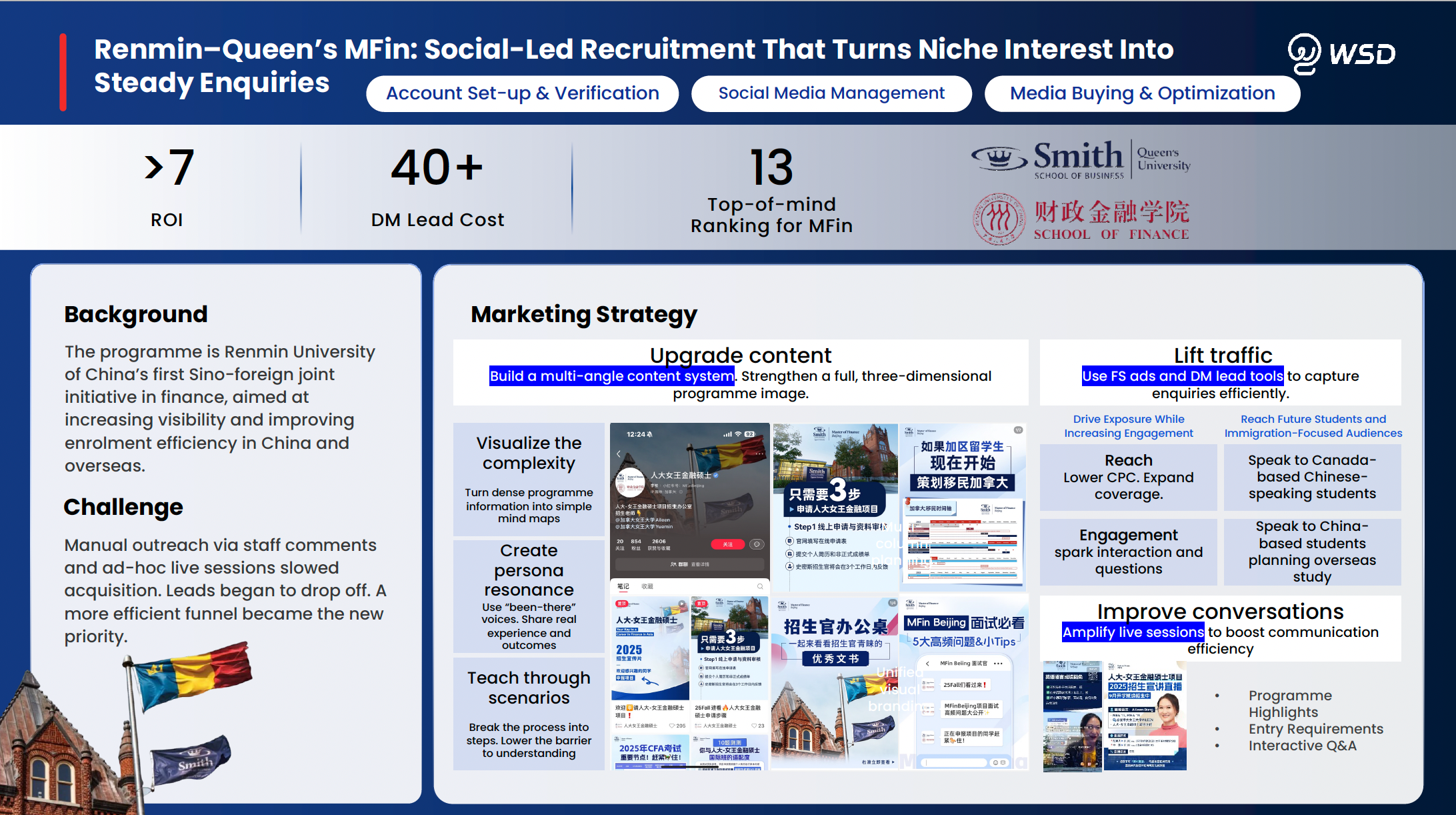
Renmin-Queen's MFin program had almost no organic search presence, a closed Zoom webinar as its main touchpoint, and admissions staff manually scanning comments for leads.
Three months later, the same program had a keyword ranking inside the top 15 results for "finance master's, a ROAS above seven, and a livestream channel feeding qualified applicants directly into its admissions pipeline. RedNote marketing for education recruitment was the channel behind that shift, and the mechanics behind it apply to almost any institution trying to reach Chinese students considering study abroad.
RedNote (also known as Xiaohongshu, Little Red Book, or RED) is where Chinese consumers go to make decisions, not just to scroll. Users treat it like a crowdsourced encyclopedia — before booking a hotel, buying skincare, or picking a graduate program, they search RedNote first, because the answers come from people who already made the choice, not from brand copy.
That behavior maps almost perfectly onto graduate school admissions. Choosing a master's program is a high-cost, high-consideration decision, exactly the kind of purchase RedNote's user base is conditioned to research there. RedNote's core demographic closely matches the profile of a prospective international graduate student.
● About 65% of RedNote's users live in first- and second-tier cities.
● More than half hold a university degree.
WSD's Social Media Management has seen this pattern repeat across education, luxury, and financial services clients: wherever the buying decision requires trust and research, RedNote outperforms closed or ad-only channels.
Implication: for institutions recruiting Chinese students, success on RedNote depends on matching this research-driven, trust-seeking behavior — not on posting volume or ad spend alone.
Challenge
Renmin-Queen's MFin program is a jointly accredited Master of Finance. A top Chinese university's school of finance and a Canadian business school run it together. Before this project, the program relied on two channels to reach prospects: manual comment monitoring and closed Zoom sessions.
Neither channel scaled, nor did it surface the program when students searched for it on their own.
The core challenge was building a RedNote presence from zero. It needed to earn organic search visibility, generate real inbound conversations, and turn those conversations into applications. And it had to happen within a three-month runway when application opens.
Execution
Content Restructuring: A RedNote Pillar System Built for Trust
The first move was not paid media. It was fixing the content itself. Admissions programs tend to publish dense, text-heavy posts that read like internal memos. They list program requirements, deadlines, and tuition figures, but have no visual hierarchy and no emotional entry point. On RedNote, that format gets scrolled past.
The account was rebuilt around five recurring content pillars, each with its own visual identity so a follower could recognize the content type at a glance:
● Admissions briefings — application steps, deadlines, and document checklists turned into scannable visual guides
● Program deep-dives — faculty, curriculum, and campus content that answers "what is this program actually like"
● An admissions think tank — real application questions answered directly by admissions staff, including sample essays
● Campus trend reports — alumni career outcomes and where graduates land after the program
● Community perks — small giveaways and welcome content that reward engagement rather than just broadcasting updates
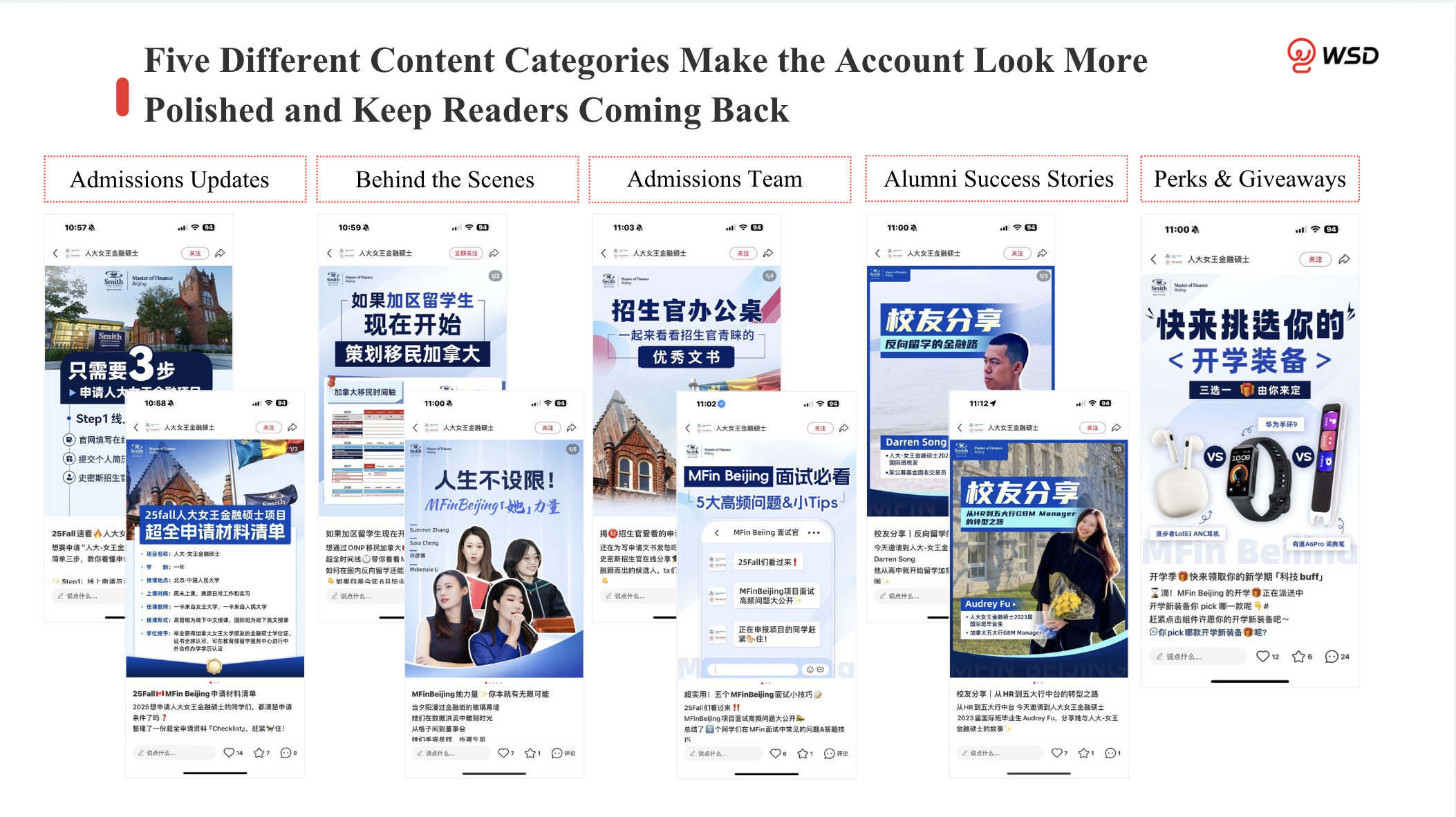
Two techniques did most of the work inside that structure.
The first was turning complex program logistics into visual mind-map graphics. This covered things like application timelines, credential requirements, and dual-degree structures. RedNote users abandon walls of text almost immediately, so this made the information easier to absorb.
The second technique was building an "insider" persona. Admissions staff and alumni posted in first person perspectives. They shared what the application process actually felt like, instead of the institution talking about itself in the third person. That shift from institutional voice to peer voice is what turns a scroll into a comment, and a comment into a direct message.
02 | Search Optimization: Turning Organic Intent Into a Traffic Advantage
RedNote's in-app search behaves less like a social feed and more like a vertical search engine, which means keyword strategy matters as much as it would for a website.
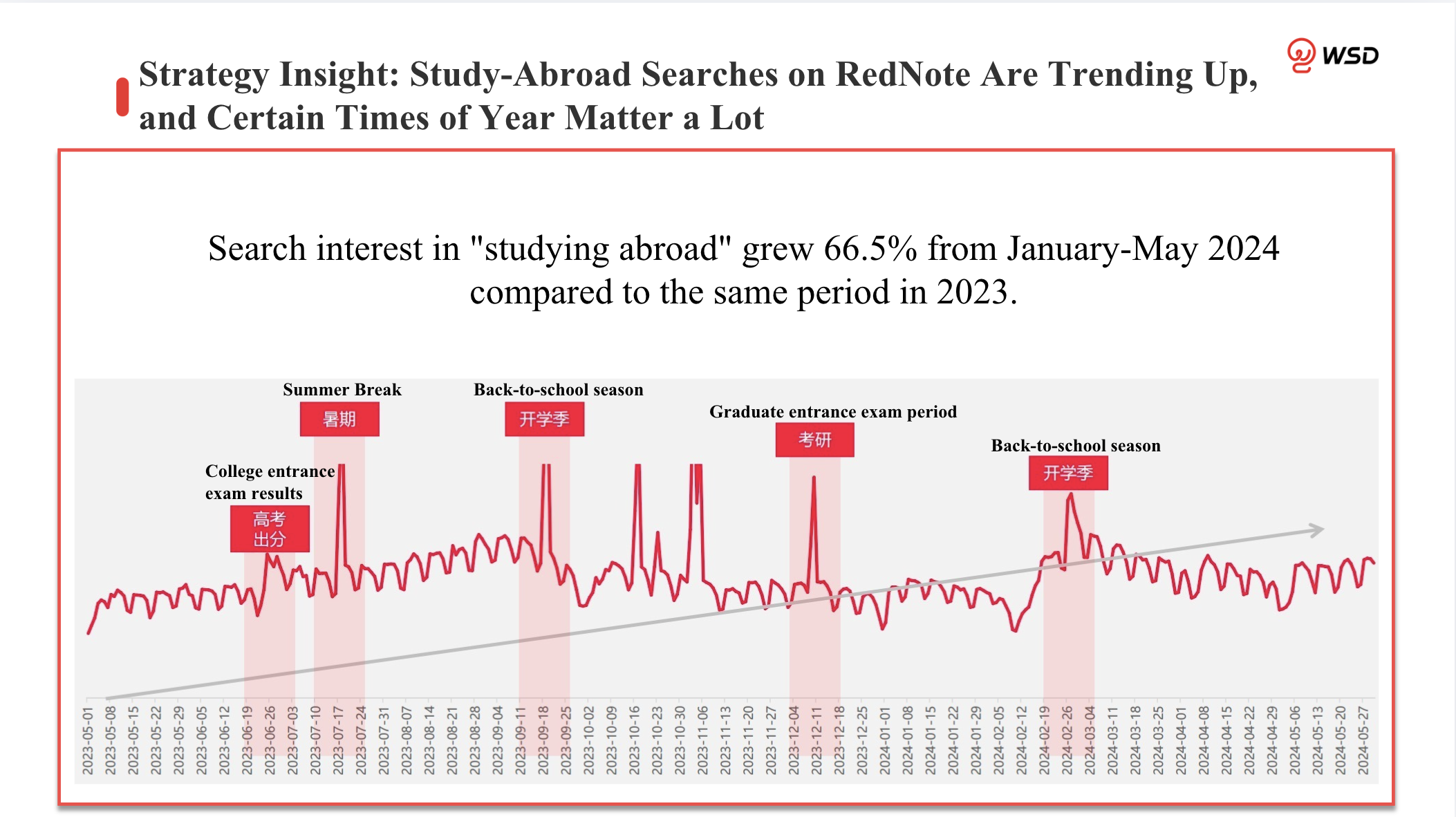
The team tracked "study abroad" search volume on RedNote and saw a 66.5% YoY increase from January to May, with sharp spikes around college entrance exam results, back-to-school season, and graduate entrance exam periods. These are predictable windows worth planning content around in advance rather than reacting to after the fact.
Each post was tagged with a curated set of roughly ten precision hashtags spanning three overlapping demand pools:
● Study abroad
● Immigration pathways
● Specific institution names
That hashtag strategy helped the program's name climb into the Top 15 search results for its category.
03 | Paid Media: Split-Objective Campaigns Without Losing Precision
Once the organic content system was producing consistent engagement, paid media was layered in. Two distinct objectives ran in parallel, rather than one blended campaign.
A click-volume campaign focused on compressing cost per click. This widened the pool of people exposed to the account. A separate engagement campaign was built specifically to drive comments and saves. These are the signals RedNote's algorithm rewards with additional organic distribution.
The paid media campaign targeted 2 distinct audience group:
- The first was Chinese international students already studying in Canada who might be considering a graduate degree locally.
- The second was students still in China actively researching study-abroad options.
By running both audiences simultaneously, rather than picking one, the funnel captured demand at two different decision stages instead of only one, maximizing audience reach and ROI.
04 | Conversion Layer: Direct Messaging and Livestreaming
Reach and follower growth mean little in education marketing without a way to move a browsing student into an actual conversation with admissions staff. RedNote's private messaging tools became the conversion layer in this case study.
Posts ended with a direct, low-friction prompt inviting readers to message the account for program details. The account also used a dedicated inbound-message routing tool. This made sure high-intent questions reached a real staff member quickly, rather than sitting in an unmonitored inbox.
RedNote unlocks livestreaming once an account crosses 1,000 followers. The WSD team treated that threshold as an explicit milestone to unlock new paths for user conversion, not just a result of growth. We reached that milestone within the first three months of the account's relaunch. That opened a new format: live admissions briefings hosted directly by the program's admissions director. These briefings livestreamed to audiences in both Canada and China, with bilingual scheduling to account for the time difference. It's like hosting an admission webinar that anyone can drop in at anytime.
Livestreaming closes a gap that static posts cannot. A prospective applicant can type a question about English-language waivers, GPA requirements, or scholarship eligibility. They get an answer in real time, from the person who actually makes admissions decisions. That immediacy is hard to replicate with a comment thread, which might take days to get a reply. This is part of why livestream sessions are becoming standard in cross-border education marketing, rather than just a nice-to-have addition.
What made the livestream strategy work cross-border: the team scheduled sessions around both Eastern and Pacific time zones for the Canadian audience, and Beijing time for the China-based audience. Neither group had to accommodate the other. Session titles also referenced specific, searchable topics — waiver eligibility, scholarship criteria, application deadlines — instead of generic "info session" language. This helped the livestream previews surface in search as well.
Curious what a livestream-driven admissions funnel could look like for your program? WSD’s team can walk through the platform mechanics and staffing model.
Result
- Keyword ranking inside the top 15 search results for "finance graduate program" (金融硕士)
- Over 40 inbound direct message conversations generated from content
- Cost per message lead of roughly 1,056 RMB against a high-value program
- Documented return on ad spend above 7x once conversations converted into actual enrollments
- Follower base crossed 1,000 within three months, unlocking livestream access with no prior format experience
Key Takeaways
- Fix the content system before adding paid spend. Visual, peer-voice content earns trust that ad spend alone cannot buy.
- RedNote functions as a search engine for high-consideration decisions, not just a social feed. Hashtag and keyword strategy matter as much as post quality.
- Split-objective paid campaigns — reach and engagement, run in parallel — outperform a single blended campaign.
- Direct messaging is the real conversion layer. Follower growth without a message-routing system leaves leads unclaimed.
- Livestreaming closes a trust gap static content can't. Treating the follower threshold as a milestone speeds up the timeline to unlock it.
Frequently Asked Questions About RedNote Marketing for International StudentRecruitment
Is RedNote worth using for international student recruitment?
Yes, particularly for graduate and professional programs where the decision is research-heavy. RedNote's user base actively searches the platform before committing to major purchases, including education. That makes it a stronger discovery channel than closed webinar tools for reaching students early in their decision process.
How long does it take to see results from a RedNote education marketing strategy?
This case study reached meaningful follower growth, a top-15 search ranking, and measurable ROI within roughly three months. Results depend on posting consistency and content quality. They also depend on whether paid media supports organic growth from the start, rather than being added later.
What's the difference between organic and paid RedNote strategy for education brands?
Organic content builds search visibility and trust through consistent, well-tagged posts. Paid campaigns extend reach to audiences who haven't found the account yet. The strongest results come from running both together — paid media amplifies content that's already proven to drive engagement organically.
Do institutions need a Chinese-speaking team to run a RedNote account?
Effectively, yes. This goes beyond language fluency. It requires understanding platform-specific behavior: how users search, what content formats they trust, and how to respond to direct messages appropriately. A translated version of existing content isn't enough — the team needs to understand the platform's culture.
How does RedNote messaging fit into an admissions funnel?
Direct messages function as the point where a browsing prospect becomes an active applicant conversation. High-intent messages need to reach a real staff member quickly, rather than sitting in an unmonitored inbox. That routing step is often the difference between a strong follower count and an actual increase in applications.Note: Add FAQ schema markup to this section for PAA and AI Overview eligibility.